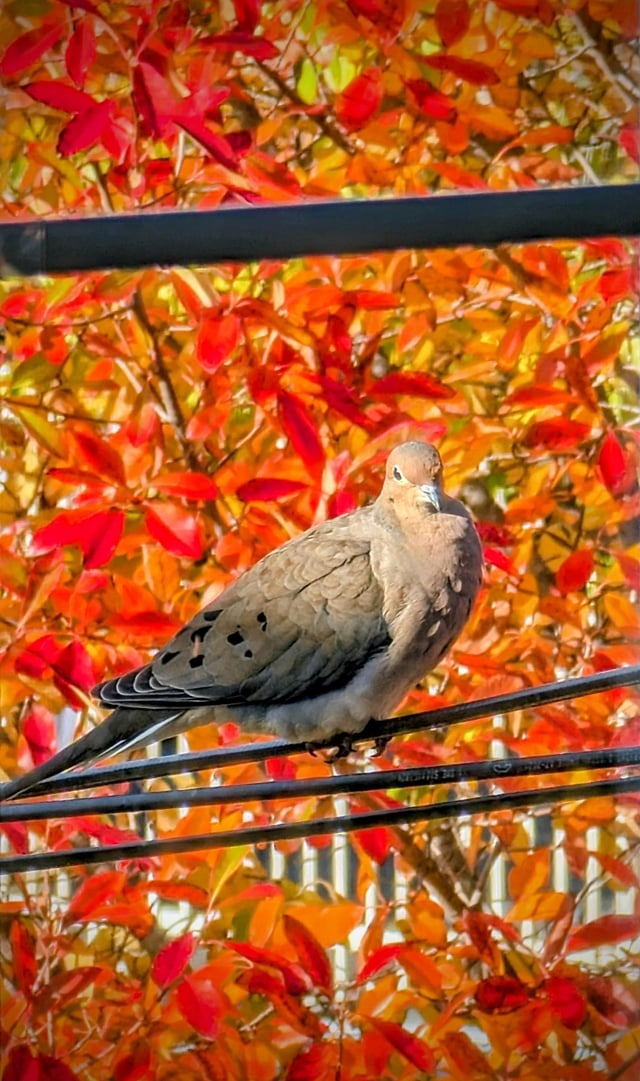
A tan-gray dove with a small head, dark wing spots, and a long pointed tail is a Mourning Dove. A low coo and a sharp wing whistle at takeoff confirm it. A square-ended tail, black nape collar, or prominent white wing panel means you are looking at a different dove.
The Mourning Dove (Zenaida macroura) belongs to the pigeon and dove family, Columbidae. You will see it on lawns, wires, and bare ground, and its muted color comes with several distinctive marks.
How to Identify a Mourning Dove by Sight
Start with the shape: a fairly full body, a small rounded head, a thin dark bill, and a long tail that narrows to a point. The legs are short and pinkish. On a telephone wire the silhouette still gives the bird away when the plumage colors disappear against the sky.
The upperparts are warm gray-brown or buffy tan. Small black spots break up the folded wing feathers, and the breast carries a soft peach tint. A dark spot near the cheek is visible on a well-lit adult, unless the angle of the head hides it.
A departing bird spreads its pointed tail and shows white on the outer feathers. You won’t see those pale edges when the tail is closed.
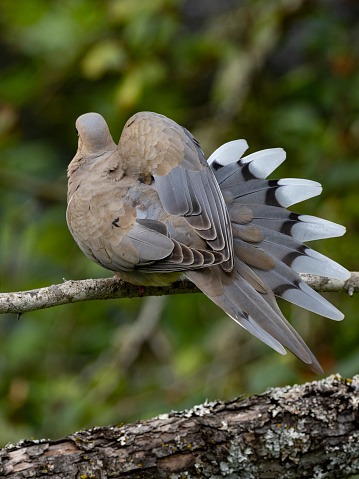
The Cornell Lab identification guide lists male Mourning Doves at 9.1 to 13.4 inches (23 to 34 cm) long, with a wingspan of about 17.7 inches (45 cm). That gives you scale, but the bird’s proportions are the better clue in a yard.
Young Mourning Doves often have pale feather edging that gives their backs and wings a scaly look. Adult males can look slightly pinker below or bluer-gray on the crown, but the sexes overlap.
- Look for the long, tapered tail, especially when the bird turns or takes flight.
- Find the scattered dark spots on the folded wing.
- If the tail or wing is hidden, check for the small head and comparatively full body.
If the bird is partly hidden, the four-keys approach to bird identification ties head shape, wing marks, and tail outline to the setting where you saw it.
What Does a Mourning Dove Sound Like?
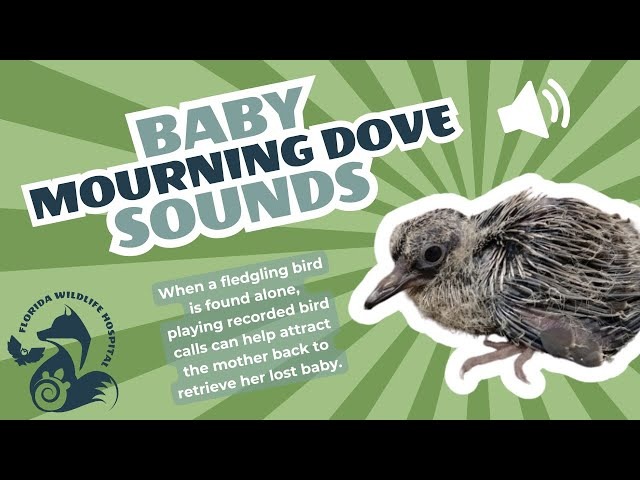
The low coo comes from the bird’s voice. The short, high-pitched whistle as a Mourning Dove takes off or lands comes from air moving over its wing feathers.
The Cornell Lab sound guide separates the male perch-coo from the nest call, given by paired males.
| What you hear | Typical context | Made by |
|---|---|---|
| Soft opening followed by louder coos | Bird calling from a perch | Vocal perch-coo, often from an unmated male |
| Three-part phrase with a higher middle note | Nesting communication | Vocal nest call |
| Brief, sharp whistle | Launch or landing | Wing feathers moving through air |
A coo heard through leaves or an open window can sound owl-like. The Eurasian Collared-Dove sings a repeated three-syllable “koo-KOO-kook,” with a longer, emphasized middle syllable, and a Mourning Dove’s nest call is three-part as well. When the caller stays hidden, compare the full rhythm with the recordings in the sound guide.
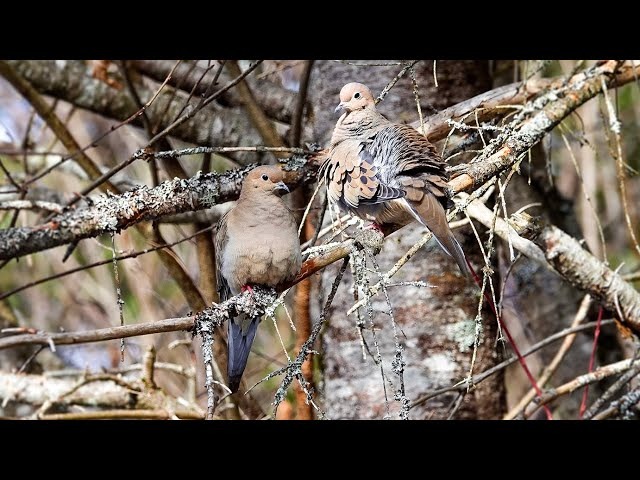
The wing whistle stands out when a bird walking quietly on the ground suddenly flies. Cornell’s wing-sound recording lets you compare that brief noise directly.
Mourning Dove vs. Similar Doves: Which Field Marks Matter?
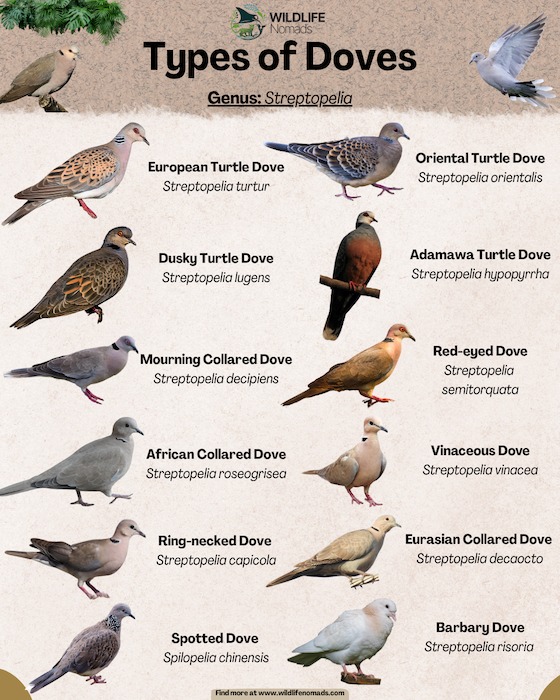
When a dove looks right but one mark seems off, compare the tail, neck, and wings with the nearest alternative found in your region. The differences are easiest to use when you know whether the bird was perched, flying, or in juvenile plumage.
| Bird | Shape and tail | Field mark to check |
|---|---|---|
| Mourning Dove | Small head; long pointed tail | Scattered black wing spots; white edges on outer tail feathers |
| Eurasian Collared-Dove | Larger-looking; more square-ended tail | Dark half-collar on rear neck; lacks Mourning Dove-style black wing spots |
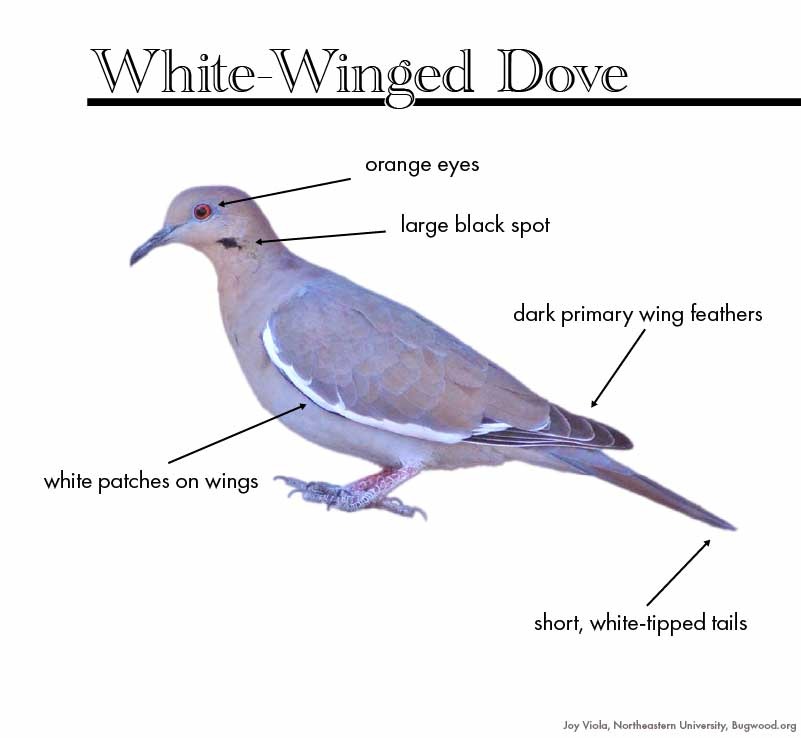
| White-winged Dove | More square-ended tail | Broad white wing panel, visible on folded wings and striking in flight |
| Rock Pigeon | Heavier build; shorter-looking tail | Variable plumage; body proportions carry more weight than color |
| Inca Dove | Small; relatively square tail | Scaly-looking feathers and chestnut wing patches revealed in flight |
| Common Ground Dove | Small, compact; short square tail | Pinkish or reddish base of the bill |
The Cornell Lab species comparisons separate a juvenile Mourning Dove’s pale-edged, scaly-looking feathers from the more extensive scaling of an Inca Dove. Size and local occurrence help most when a young bird is photographed with nothing beside it for scale.
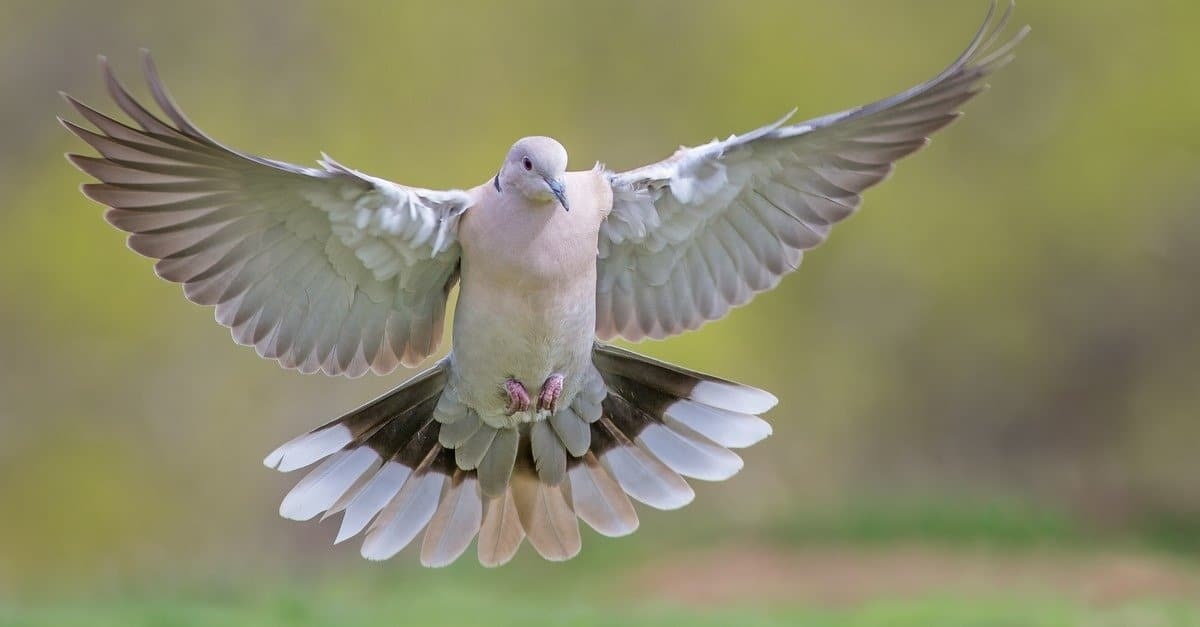
A black collar is hard to see on an immature Eurasian Collared-Dove or on a bird facing away. The Missouri Department of Conservation notes that Eurasian Collared-Doves can show dark wingtips while perched, which gives you another clue when the collar is hidden.
A brief flyover with the tail hidden supports only a tentative record. The same method of comparing look-alike birds by tail and wing pattern works beyond doves.
Where Mourning Doves Live in the United States
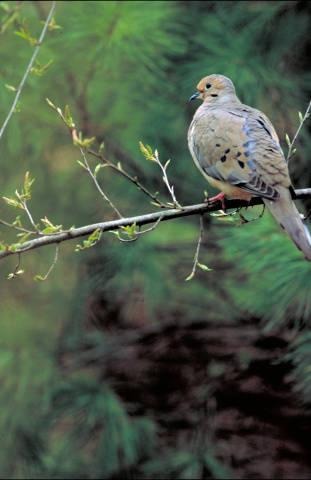
Mourning Doves live in open and partly open landscapes across much of the United States, including farms, grasslands, suburbs, woodland edges, and places with scattered trees or wires. Some stay through winter, while many northern birds move south, so occurrence varies by season and location. To judge a local sighting, check your state and season against eBird Status and Trends. Its 2025 release models 2023 distribution from observations collected between 2009 and 2023. The result is a seasonal estimate, not a report of a bird at one address today.
What Mourning Doves Eat and Why One May Visit Your Feeder
Mourning Doves eat mainly seeds. Cornell reports that seeds make up about 99% of their diet, including seeds from grasses, weeds, and cultivated grains. Snails and a few other foods have been recorded.
On a lawn or patch of bare earth, the bird walks and pecks at individual seeds, nudging light litter aside with its bill. Seeds collect temporarily in its crop, so the bird can gather them first and digest them elsewhere.
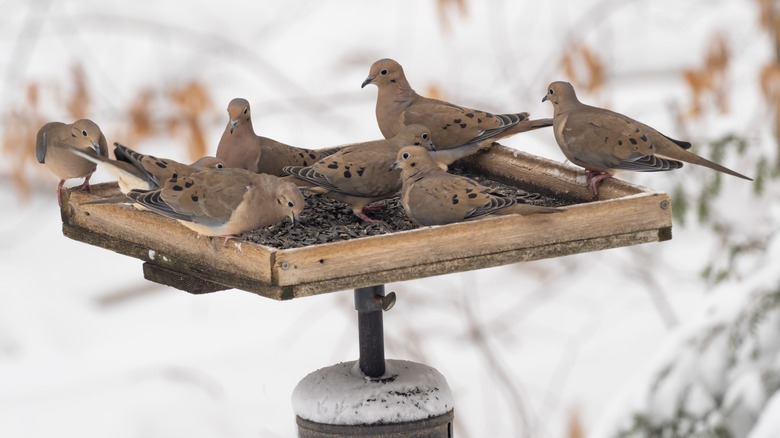
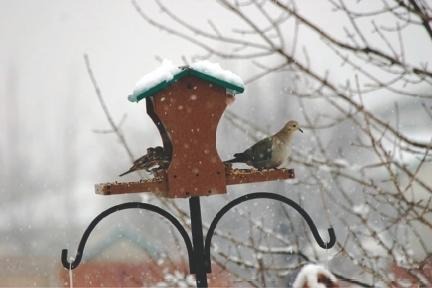
Spilled seed beneath a backyard feeder gives these ground-foraging birds an easy meal. They also use broad platforms and other raised feeders.
Watch where the dove collects seeds and whether the feeder gives its body and feet enough room. For help picking seed, see choosing seed for the birds using a backyard feeder, which considers the mix of visitors and available seed types.
Mourning Dove Nests, Eggs, and Young
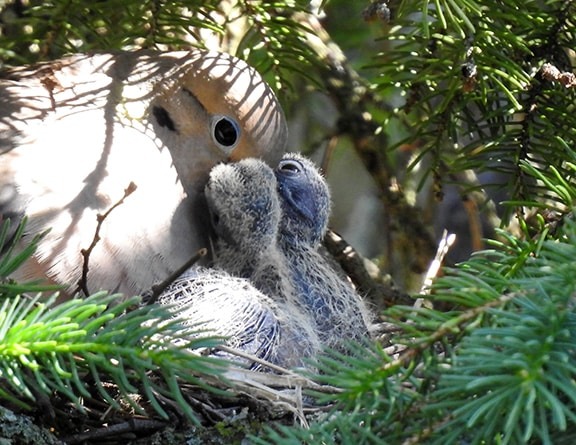
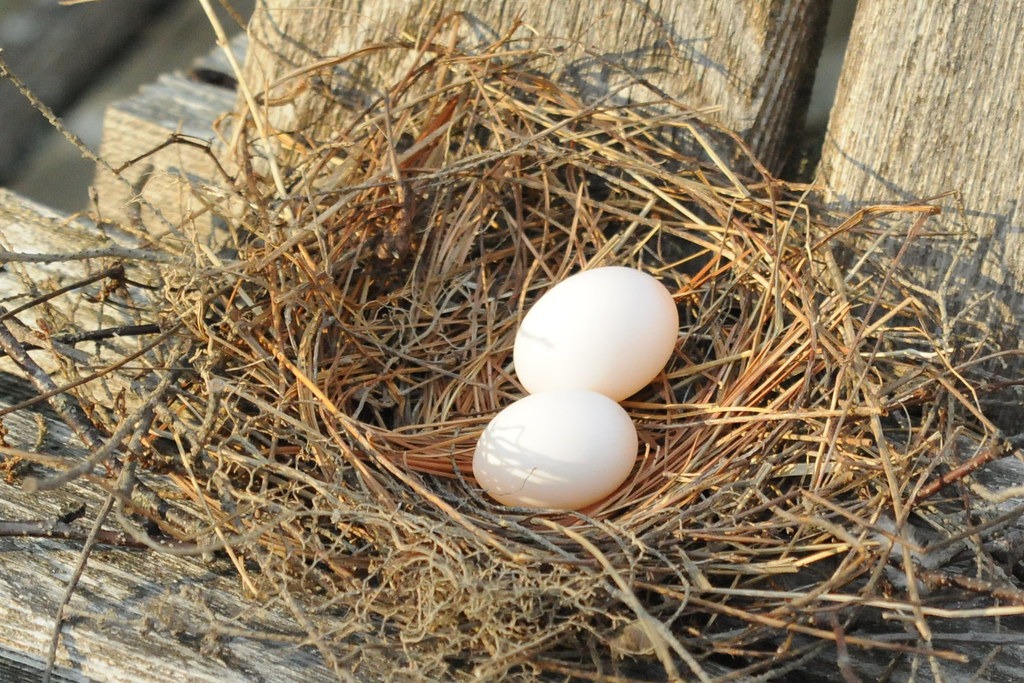
A Mourning Dove nest can look startlingly thin: a loose platform of twigs, grass, and pine needles, sometimes with gaps showing through. Nests occur in trees, shrubs, vines, and occasionally on the ground, as well as on ledges, eaves, gutters, or suitable outdoor structures.
Males bring the nest material and females arrange it, according to Cornell.
| Nesting detail | Figure |
|---|---|
| Nest diameter | About 8 inches (20 cm) |
| Construction | About 2 to 4 days |
| Clutch | Usually 2 unmarked white eggs |
| Incubation | About 14 days |
| Time young spend in nest | About 12 to 15 days |
Once the young leave the nest, the parents keep feeding them nearby.
Both adults feed their chicks. Early meals include crop milk, a nutrient-rich secretion produced by the parents’ crops.
Mourning Doves raise repeated broods when conditions allow. Cornell lists one to six per year.
If you follow a nest, watch from a distance and record the date and the visible stage: eggs, young in the nest, or an apparently vacated platform. An empty nest means the young fledged, the attempt failed, or something else happened. The nest won’t tell you which.
When a Dove’s Nest, Young, or Window Behavior Raises Concern
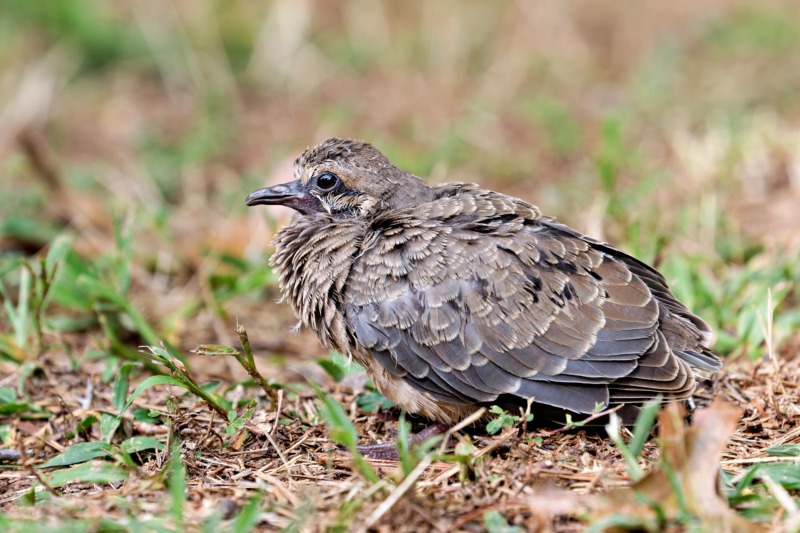
A young Mourning Dove on the ground can be a fledgling in normal development. A fully feathered, alert bird can be outside the nest while its parents stay nearby. A younger nestling often shows bare skin or incomplete feathers.
The nestling and fledgling identification guide compares feather development and parental care in more detail.
| What you see | What to do |
|---|---|
| Alert, fully feathered young bird outside the nest | Give the parents room to approach and watch from a distance |
| Young nestling with bare patches or incomplete feathering | If uninjured and the original nest is safely reachable, return the nestling to it. Otherwise seek guidance from a qualified wildlife organization. |
| Injured bird or one facing immediate danger | Contact a qualified wildlife rehabilitator or wildlife veterinarian |
| Active nest on a door mechanism, heater, or other equipment | Keep the equipment from endangering the nest and consult wildlife authorities before intervention |
Cornell NestWatch advises against feeding a found young wild bird or force-feeding it water. Improvised care can harm a bird whose needs depend on its stage of development.
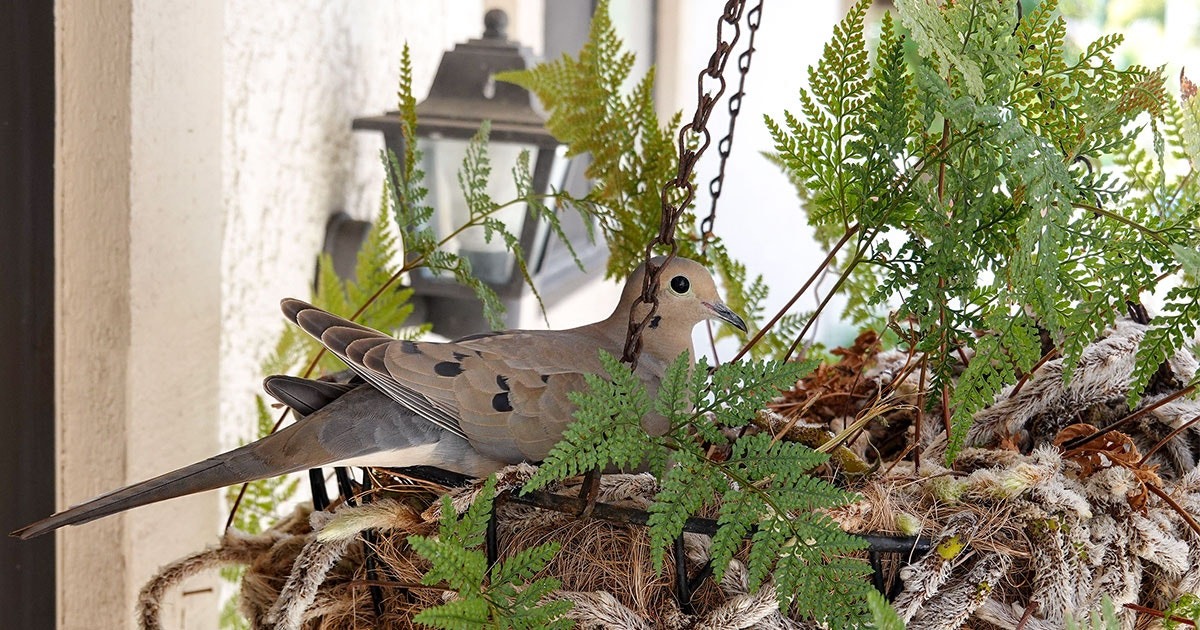
The U.S. Fish and Wildlife Service’s nest guidance explains that destroying a protected nest containing eggs or dependent young without authorization is prohibited. Inactive nests are treated differently under federal law, and state or local restrictions may also apply.
You can’t tell why a dove keeps hitting a window just by watching it. Reflection is one possible reason. The separate guide to making windows safer for birds deals with the glass hazard whatever the cause.