Range gives you the likeliest species. A clear look at the wing and nape, or a song you can tie to the bird, confirms it. Near the contact zone, or when the clues disagree, record a Black-capped/Carolina Chickadee pair. For plumage, range, and song in more depth, see Carolina Chickadee identification and field marks.
Which Chickadee Is More Likely?
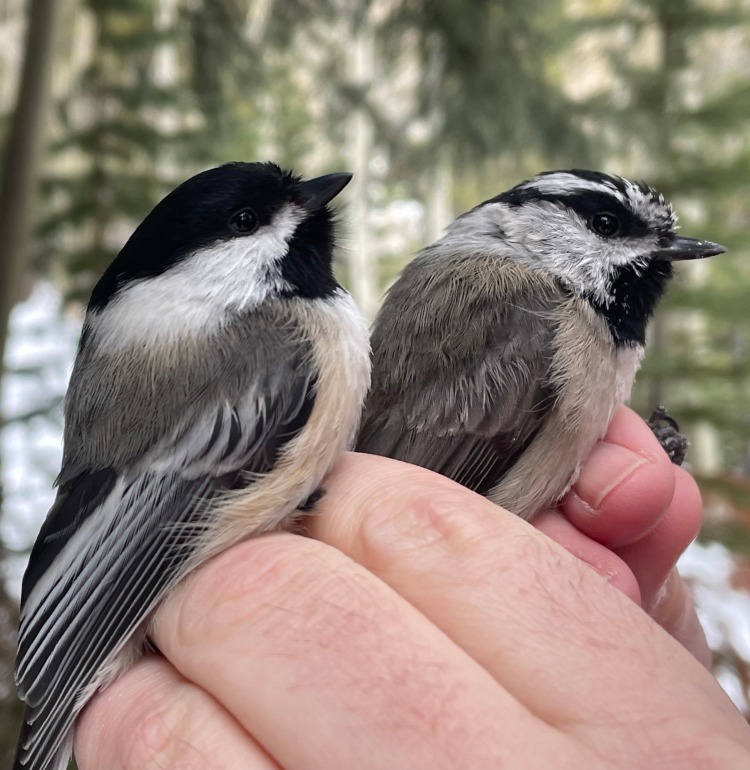
Black-capped Chickadees (Poecile atricapillus) and Carolina Chickadees (Poecile carolinensis) share black caps, dark throat bibs, white cheeks, and gray bodies. Black-cappeds are predominantly northern birds, while Carolinas occupy much of the southeastern United States. The trouble starts where the species meet. There, even a plausible song and several visible marks can leave a bird’s identity unsettled.
Start With Range, Elevation, and Season
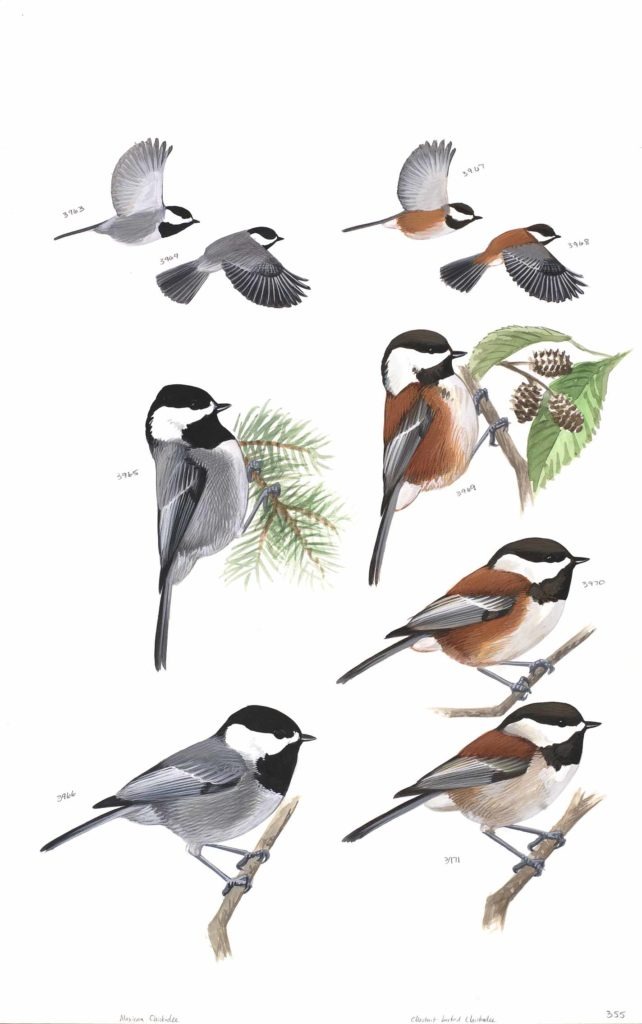
Location narrows the options before the bird gives you a good view. Black-capped Chickadees occupy much of the northern United States and Canada. Carolina Chickadees are expected across much of the Southeast. Their ranges approach each other in a narrow, irregular belt running broadly from New Jersey toward Kansas.
In the Appalachians, elevation complicates the north-versus-south map. Black-cappeds may occupy higher ground while Carolinas sit at lower elevations nearby. Some Black-cappeds also wander south of their usual range in winter, so the expected local species is a starting judgment about likelihood.
The National Park Service describes Carolina Chickadees across much of the National Capital Region, with complications around Catoctin Mountain Park and the upper Chesapeake & Ohio Canal corridor, where the species meet.
Writing in 2013, Kenn Kaufman described the hybrid band as often no wider than about 20 miles.
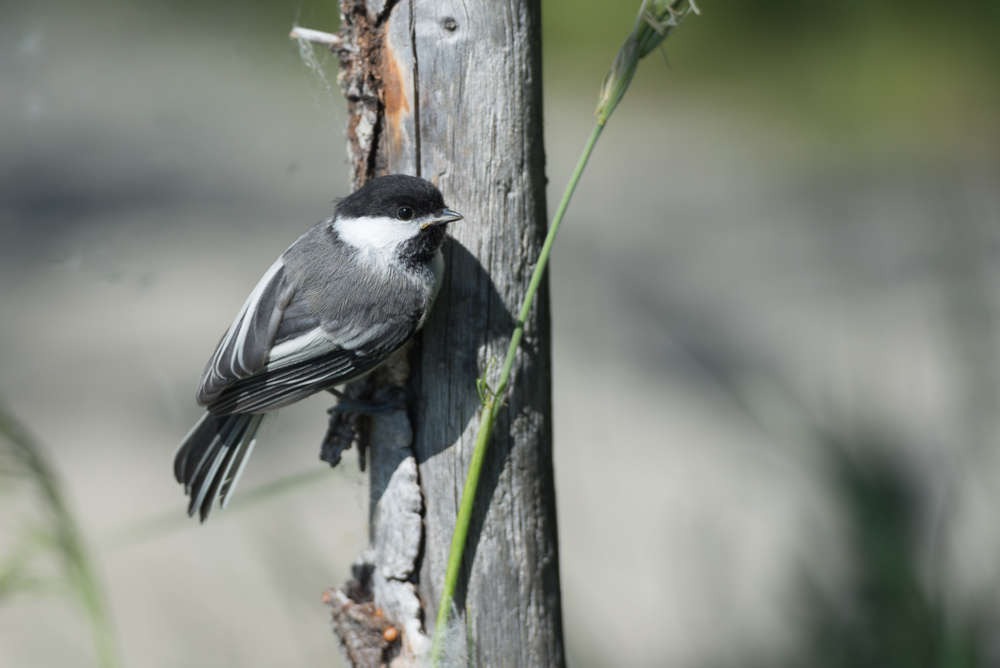
Check a dated local distribution or status resource for the species expected at your locality and season, and note the elevation on ridges and in valleys. Range maps age, so look at the date. An unexpected recorded song or app suggestion is easier to judge against that local picture.
Compare the Wing, Nape, Bib, and Tail
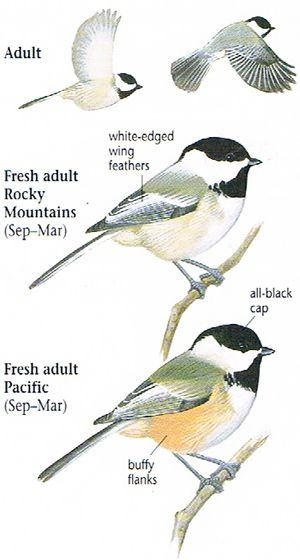
On a well-seen bird, pale feather edging on the folded wing and the color behind the white cheek are the most useful marks. The two species overlap in appearance, so rely on several consistent features, not one.
The Cornell Project FeederWatch comparison describes these differences alongside average length and shape.
| Feature | Black-capped Chickadee | Carolina Chickadee |
|---|---|---|
| Folded wing | Usually broad, conspicuous pale edging on greater coverts and secondaries | Usually plainer gray, with less prominent pale edging |
| Side of nape | White cheek tends to continue cleanly toward the back of the neck | White tends to shade into gray toward the nape |
| Lower edge of bib | Often somewhat irregular | Often neater and straighter |
| Flanks | Often a warmer buff wash in fresh plumage | Often grayer, though buff can occur |
| Tail and build | Generally larger, with a longer-looking tail | Generally smaller and shorter-tailed |
| Approximate average length | 5.25 inches | 4.75 inches |
The half-inch difference in average length is a weak clue in a photo without a known scale. A crouched bird looks smaller, and one leaning forward looks longer-tailed.
Aim for a side or three-quarter view. Look at the white-to-gray transition behind the cheek, and at the dark tertials with pale edges against the back. Greater wing coverts and secondary edges add support, especially in fresh plumage. Bib outline and flank color are weaker clues. If the folded wing is hidden, don’t count wing marks at all. For the checks on bill shape, plumage, and habitat, see how shape, color, behavior, and habitat identify a bird.
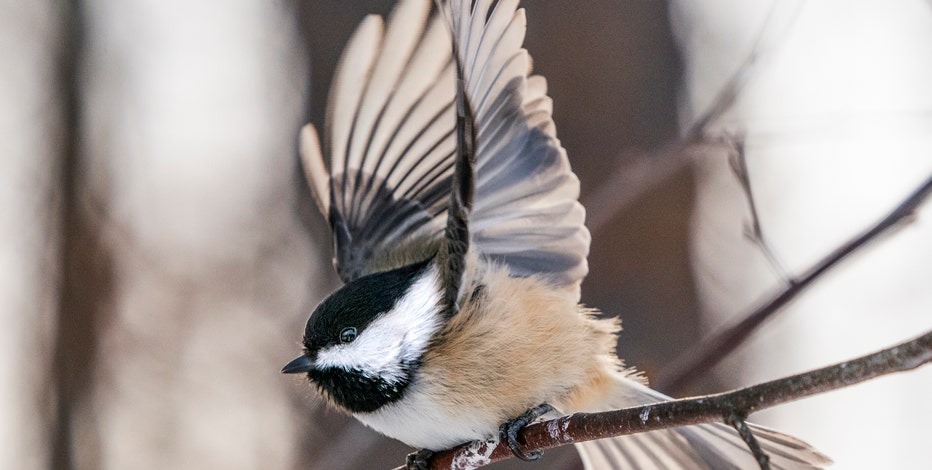
Season changes the comparison. Fresh feathers after the annual molt around midsummer to early fall show clearer contrasts through fall and winter. By late spring and summer, worn edges look duller, and direct sunlight can make a gray wing edge look surprisingly pale. A sharp autumn side view is better evidence than a backlit, worn June bird.
Songs, Calls, and Merlin Sound ID
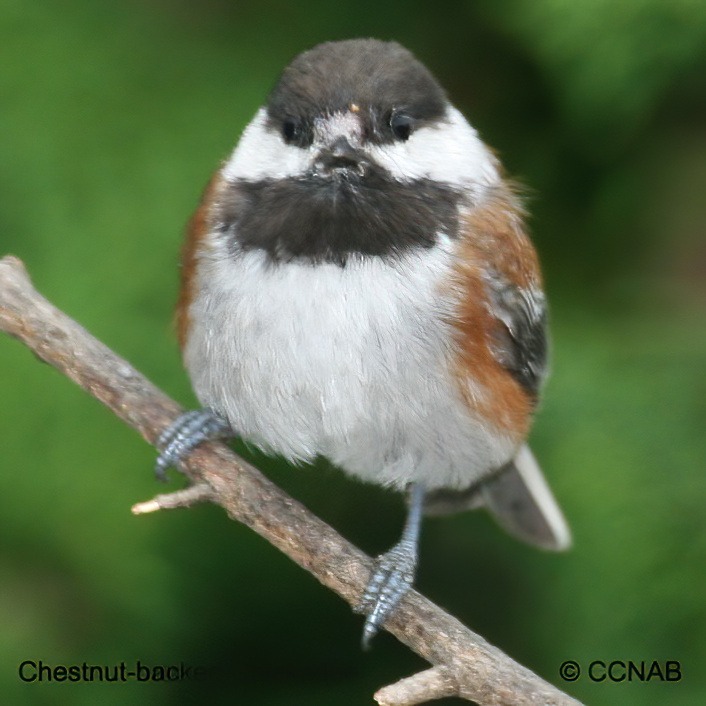
Black-capped Chickadees commonly sing a clear, descending two-part fee-bee. The familiar Carolina song alternates pitch in four parts: fee-bee-fee-bay.
Carolinas have a wider repertoire than that four-note example suggests. Sibley’s expert comparison describes songs with roughly two to six notes, including forms that sound similar to Black-capped songs. Note count is one clue among voice, location, and visible marks.
| Sound or evidence | What it tells you | How to read it |
|---|---|---|
| Clear, attributable whistled song | Characteristic pitch sequence and rhythm | Useful support alongside location and appearance |
| Rapid chick-a-dee contact calls | Voice quality and pace; Carolina can sound higher and faster | Considerable overlap between the species |
| Isolated chip | A bird called | Too little structure for a dependable pairwise ID |
| Merlin Sound ID suggestion | A candidate species tied to part of the recording | Review the actual segment and find its sound source |
| Several birds in one recording | More than one possible sound source | Keep the photographed bird and the singing bird separate until you match them |
Say you photograph a chickadee near Catoctin Mountain Park while Merlin suggests Black-capped Chickadee from a nearby song. The singer might be your bird or another one out of view. Settle that before you assign the recording to the bird in the photo. Then compare plumage, range, and song against Black-capped Chickadee identification and field marks.
Review the saved sound segment, separate a complete whistled song from the shorter contact notes, and compare the structure with trusted reference recordings. Merlin is a useful listening aid, but a screen label alone does not confirm the bird you saw. To weigh bill shape, plumage, and habitat, use the bird-identification methods as a cross-check.
Observe naturally produced sounds. Don’t play recorded songs to provoke a territorial response for this identification exercise.
Hybrids and Birds You Can’t Call
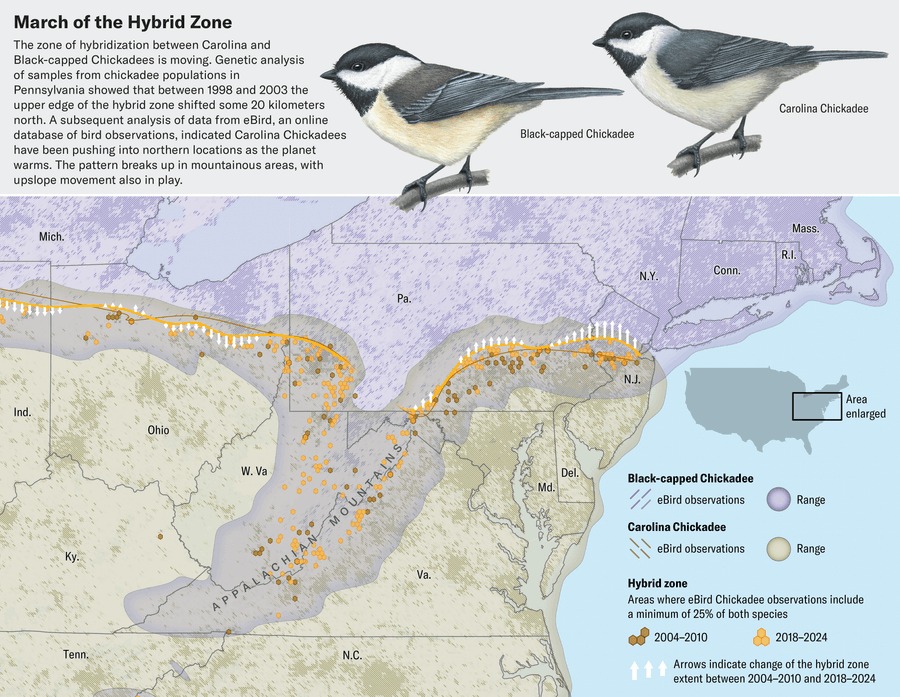
Where the ranges meet, Black-capped and Carolina Chickadees hybridize, and birds can learn songs of the other species. A chickadee giving an unexpected song may have learned it, may be a hybrid, or may be an individual you can’t identify on the evidence at hand.
Intermediate-looking plumage raises the same question. A mixed wing or nape describes appearance. Genetic ancestry needs stronger evidence. Some birds in the contact zone cannot be identified to either species in the field.
In a 2014 Current Biology study, Taylor and colleagues analyzed genetic samples from 167 southeastern Pennsylvania chickadees collected in 2000 to 2002 and 2010 to 2012. Across 1,425 genetic loci, they found 23 significantly shifted clines. Their centers had moved an average of approximately 11.5 kilometers north between the sampled periods.
A separate 2025 whole-genome study analyzed 259 chickadees, including samples from Pennsylvania and Missouri transects and reference birds from outside those transects. Earlier studies measured hybrid-zone movement in central North America at roughly one-fifth the rate in the east.
| What you observed | What to conclude | What stays unknown |
|---|---|---|
| Outside the plausible contact zone: locally expected species, clear wing or nape, and compatible voice | Species-level ID is defensible | Individual variation still applies |
| Only the shared black cap, white cheek, and gray body | Pair remains unresolved | Diagnostic feather areas unseen |
| Conflicting songs near the contact zone | Leave species assignment open | Learned song and hybridization both apply |
| Intermediate plumage with no other decisive evidence | Describe the marks without claiming hybrid ancestry | Genetic status |
How to Record an Uncertain Chickadee

You can still enter an unresolved chickadee honestly in a birding record. Keep two things apart: uncertainty about which species you saw, and evidence for an actual hybrid.
In eBird terminology, a slash taxon represents a choice unresolved between named taxa, and a hybrid taxon asserts hybrid ancestry. A broader category, sometimes called a spuh, applies when you can identify only a wider group.
| Evidence available | Reporting choice | Meaning of the record |
|---|---|---|
| Consistent evidence identifies one species | Black-capped Chickadee or Carolina Chickadee | Species-level identification |
| Clearly one of this pair, but no confident distinction | Carolina/Black-capped Chickadee slash taxon, where available | Unresolved choice between these two species |
| Chickadee identity established, pair membership uncertain | Suitable broader taxon where available | Identification limited to a higher group |
| Independent evidence supports hybrid ancestry | Appropriate hybrid taxon where available | Statement about ancestry |
For its own reporting program, Cornell Project FeederWatch explicitly recommends the designation “Black-capped Chickadee/Carolina Chickadee” for uncertain birds in the contact zone. The eBird taxonomy documentation explains slash, hybrid, and broader categories. The choices on a particular eBird checklist depend on the available taxonomy and entry context.
Choose the most specific category your evidence supports. Attach photographs, recordings, and notes on the feather or voice details you saw. If Merlin suggested two different species minutes apart, keep both suggestions as part of the encounter history. Your life list can stay open while the sighting itself is recorded accurately.
Outside the contact zone, record the species that local distribution and consistent evidence support. Keep the place, date, and evidence behind your choice.