A red bird with solid black wings and tail, seen in eastern forest during breeding or migration season, is a male Scarlet Tanager. Brown wings, white wingbars, or a sighting outside that range and season mean a different bird.
Which Red Bird Has Black Wings? Start With the Scarlet Tanager
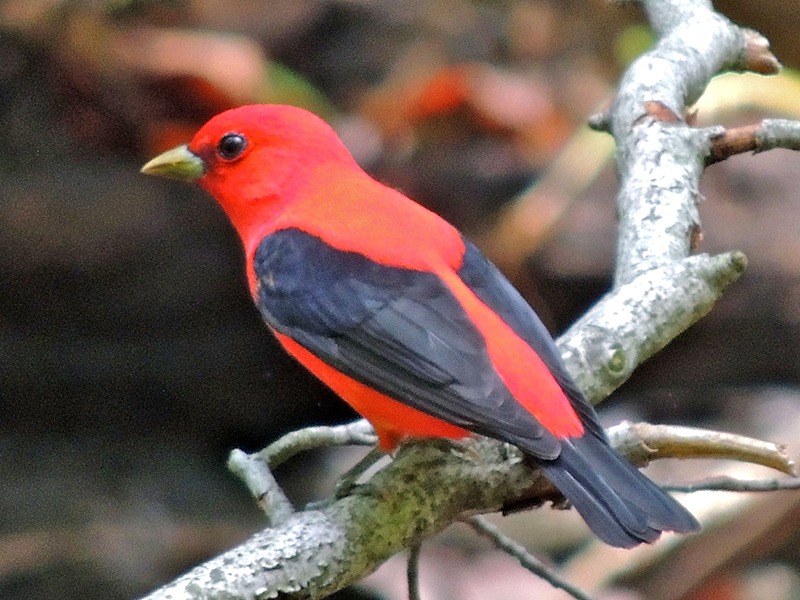
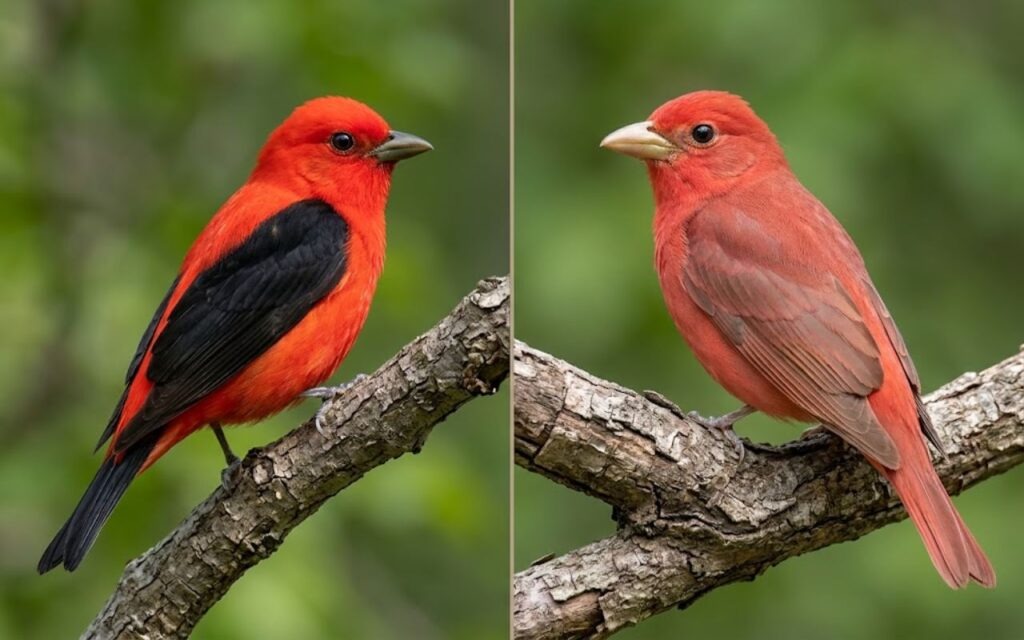
An adult male Scarlet Tanager (Piranga olivacea) in breeding plumage is brilliant red across the body, with black folded wings and a black tail. The black is solid, with no white wingbars. Check wings and tail when the bird turns sideways. The tail is easier to see from below.
This stocky songbird measures 6.3 to 6.7 inches (16 to 17 cm), according to Cornell’s Scarlet Tanager guide. It breeds mainly in eastern deciduous and mixed forests, often in the canopy. Migrants also turn up in other habitats.
| Match type | Bird | Where the red is | Actual wing pattern | Next useful clue |
|---|---|---|---|---|
| Closest | Scarlet Tanager, breeding male | Most of body | Solid black wings and tail | Stocky forest songbird; no bold white bars |
| Conditional | Vermilion Flycatcher, male | Head and underparts | Dark-brown back, wings and tail | Eye mask; exposed insect-catching perch |
| Conditional | White-winged Crossbill, male | Rosy-red body | Black wings with two white bars | Crossed bill tips |
| Conditional | Pine Grosbeak, male | Rosy red mixed with gray | Dark-gray wings with two white bars | Large, rounded shape and stout bill |
| Conditional | Red Crossbill, male | Brick-red body | Dark brownish-red wings | Crossed bill; conifer habitat |
| Lookalike | Summer Tanager, adult male | Whole body | Red wings and tail | Heavy tanager bill |
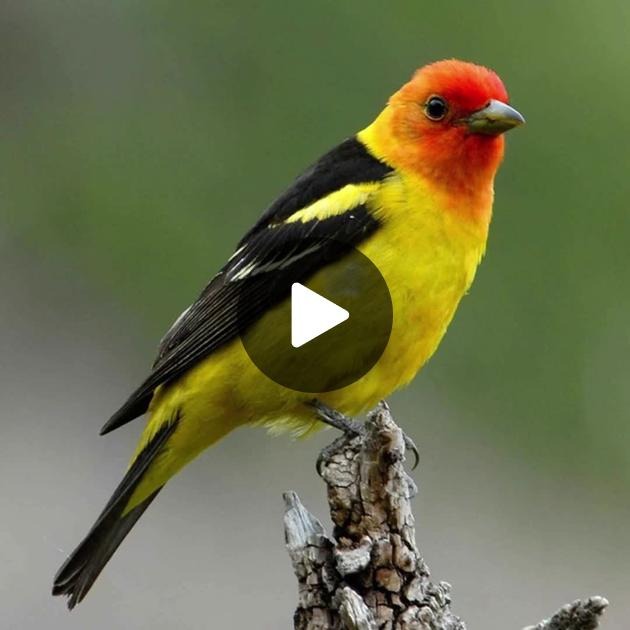
| Lookalike | Western Tanager, breeding male | Red-orange head, yellow body | Black wings with pale bars | Yellow underside |
| Lookalike | Northern Cardinal, male | Whole body | No solid contrasting black wing panels | Crest, dark face mask, thick red bill |
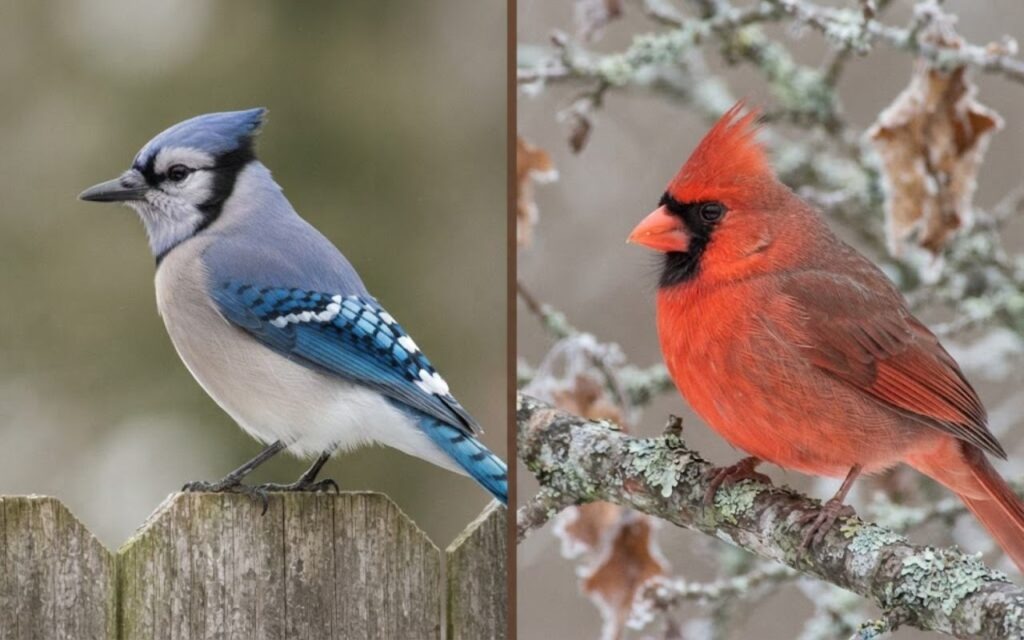
Sort the wing first: a solid black panel, dark brown or gray feathers, or black crossed by white bars. A red head above a yellow body, or a conspicuous crest, means a different bird.
Scarlet Tanager vs. Summer Tanager: Wing and Tail Color
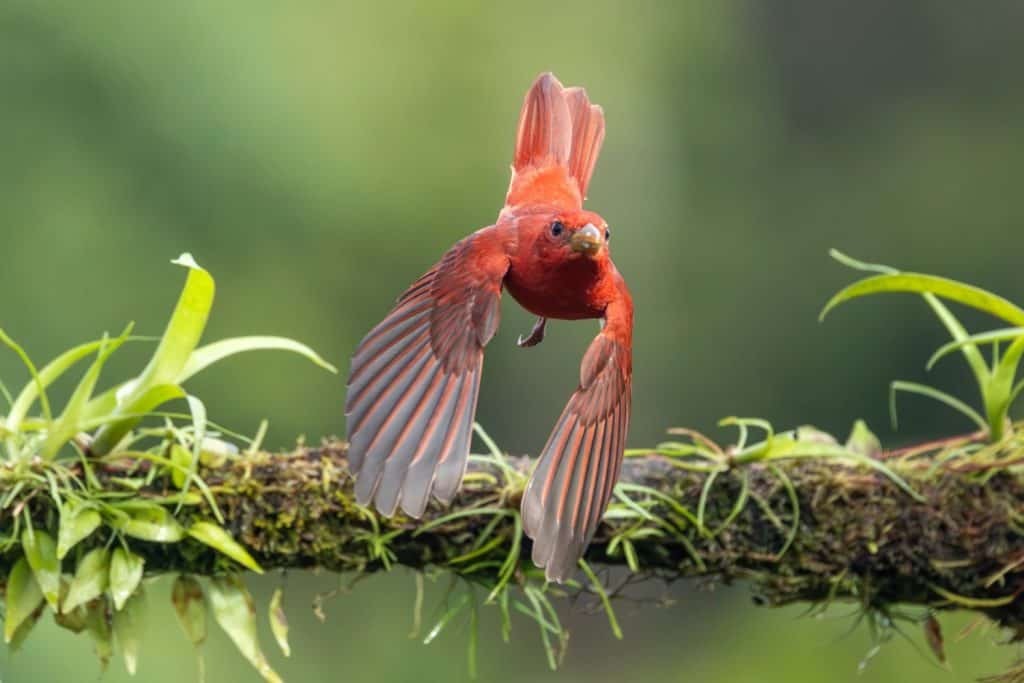
An adult male Summer Tanager is red across its body, wings, and tail. A breeding male Scarlet Tanager has the same striking red body with black wings and tail. The difference shows best in an evenly lit side view.
Shade can make red wings look nearly black. A sharply bounded dark panel on the folded wing means Scarlet Tanager. Uniformly red feathers reaching the tail mean Summer Tanager. Both have thick, blunt-tipped bills, and the Summer Tanager’s is larger.
Length won’t separate them: Cornell lists the Summer Tanager at about 6.7 inches (17 cm), overlapping the Scarlet Tanager’s 6.3 to 6.7 inches. Females and young birds may be yellowish or patchy, so the red-versus-black comparison works on adult breeding males.
Could It Be a Vermilion Flycatcher Instead?
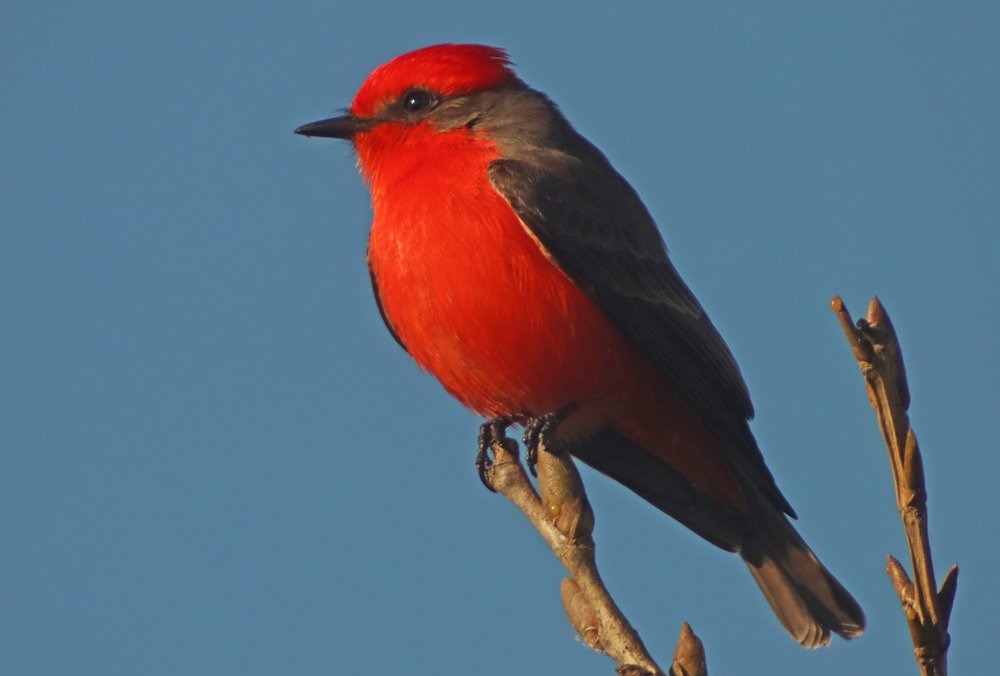
A male Vermilion Flycatcher has a bright orange-red head and underparts, with a dark eye mask, back, wings, and tail. Cornell describes those upperparts as brown, though they can look almost black at a distance. This small flycatcher measures about 4.8 to 5.4 inches (12.3 to 13.8 cm).
It sits on an exposed perch, darts into the air after an insect, and returns to watch for the next one. Its compact, upright stance differs from the larger, stockier tanager. Compare these marks with Cornell’s Vermilion Flycatcher account.
Look for open scrub, desert edges, and riparian areas in the Southwest. In Texas, Vermilion Flycatchers and migrating Scarlet Tanagers can both be on your shortlist, so check the face pattern and behavior.
An April 2026 birding post from Austin, Texas, described a red bird with dark-looking wings, a dark bill, and an eye stripe. The observer considered Vermilion Flycatcher; the identification remained unresolved.
Red Finches With Dark Wings: Wingbars and Bills
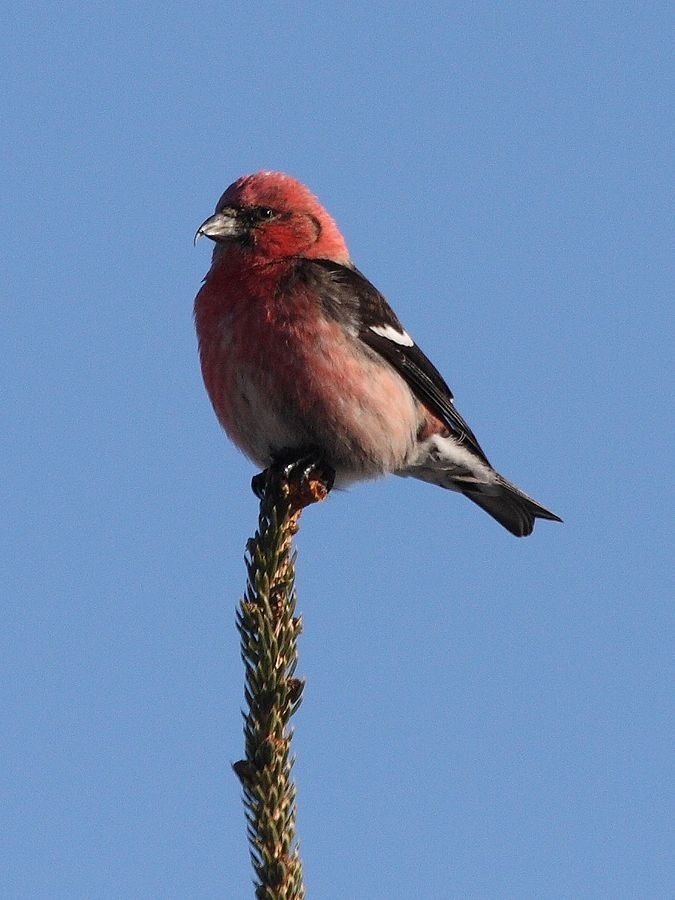
Two white bars on otherwise dark wings point to northern finches. Bill shape separates birds whose red and gray plumage looks similar in poor light.
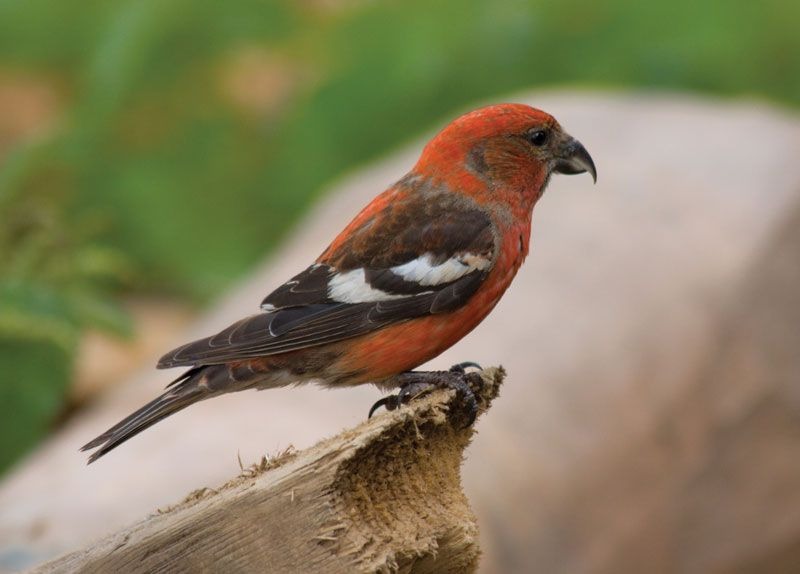
- White-winged Crossbill: Its crossed bill tips extract seeds from conifer cones. The two bold white wingbars separate it from a typical male Red Crossbill. See Cornell’s White-winged Crossbill guide.
- Pine Grosbeak: A much bulkier, round-bodied bird with a stout, uncrossed bill. Cornell lists its length at 7.9 to 9.8 inches (20 to 25 cm), noticeably larger than the White-winged Crossbill.
- Red Crossbill: It shares the crossed bill, but its brownish wings typically lack the bold white pair. Males range from red to brick red.
Crossbills forage on conifer seeds, and their movements shift with cone crops. White-winged Crossbills sometimes wander south during irruptive periods.
What Else Can Look Red and Black?
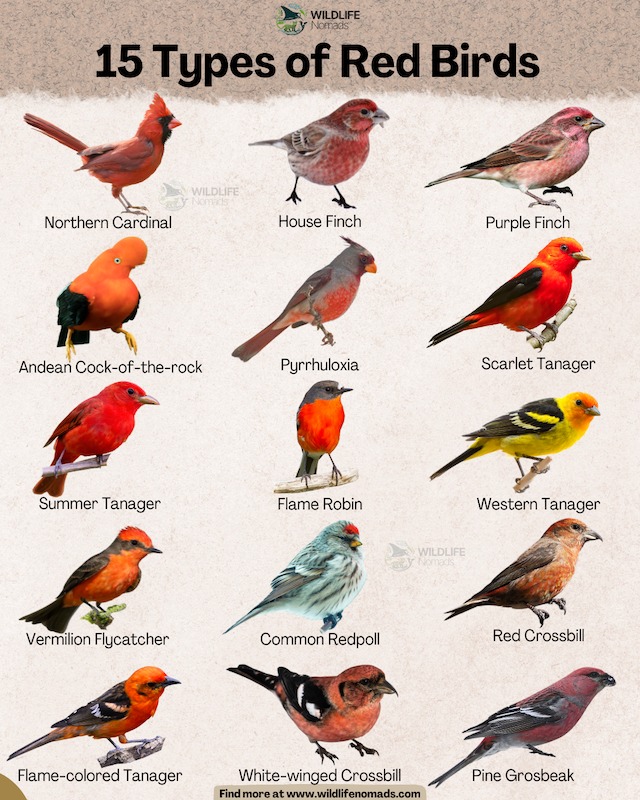
A male Western Tanager has a red-orange head above a yellow body and barred black wings. A male Northern Cardinal has a crest, black facial mask, and heavy reddish bill. A male Red-winged Blackbird is mostly black with red shoulder patches. A male Rose-breasted Grosbeak has a red chest chevron against black-and-white plumage and a massive triangular bill. For plumage, range, and song, see Northern Cardinal identification and field marks.
What Changes With Season, Location, and Plumage?
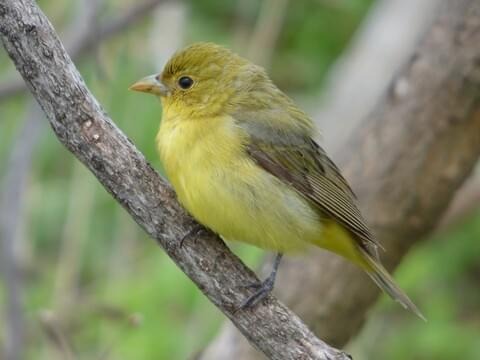
Outside breeding plumage, an adult male Scarlet Tanager turns olive-yellow but keeps its black wings and tail. During molt it shows irregular scarlet and yellow-olive patches. Females and immature birds are also generally olive or yellowish, so expect that look in autumn.
A yellowish songbird with black wings in fall still belongs in a Scarlet Tanager comparison.
Eastern woodland suits breeding Scarlet Tanagers, southwestern open habitats suit Vermilion Flycatchers, and northern conifers suit the crossbills and Pine Grosbeak. Migration and irruptive movements produce unusual records.
Write down the state or county, month, habitat, and whether the bird was feeding or moving through.
How to Confirm an ID When the Photo or Merlin App Is Uncertain
Cornell’s four keys to bird identification are size and shape, color pattern, behavior, and habitat. Use them to judge what a photograph, field observation, or recording supports. For a cross-check, see how shape, color, behavior, and habitat identify a bird.
Distance and tricky lighting can hide the marks that separate similar birds. An image may show a bright breast and dark wing while hiding the bill, tail, or face.

Merlin Sound ID suggests birds that may be calling nearby, but the singer and the photographed bird can be different individuals. Cornell’s Merlin Sound ID guidance recommends checking suggested sounds against recordings before reporting them.
When the evidence is mixed, handle each source on its own:
- Review the original records: treat the sighting, the photo, and the song as separate evidence, and note what each one captured.
- Compare independent references: check a trustworthy species account and a reference recording for the proposed bird.
- Record an honest result: report a species when the marks support it. Otherwise log a tentative Scarlet Tanager or an unidentified red songbird.
Check the bill, markings, and behavior against a reliable field guide before recording a definite species.