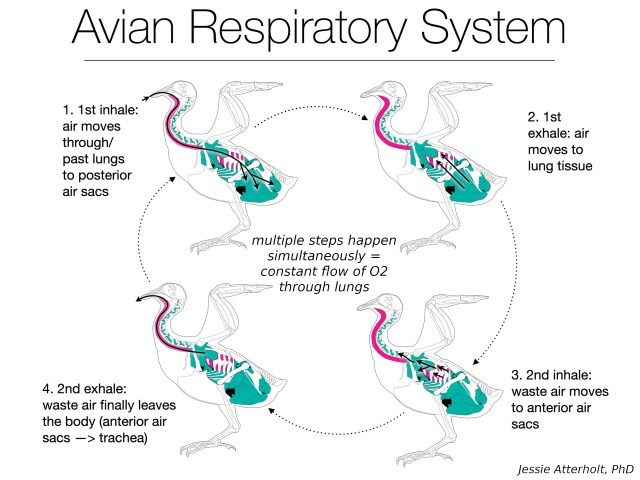
Birds breathe with air sacs that ventilate rigid lungs, where oxygen enters the blood and carbon dioxide leaves it. In the two-breath cycle, one parcel of air travels through posterior sacs, lungs and anterior sacs before leaving, while other air keeps moving through the system. To read feeding, flight, and roosting behavior, check the bird-behavior explanations.
What Do Birds Use to Breathe: Lungs or Air Sacs?
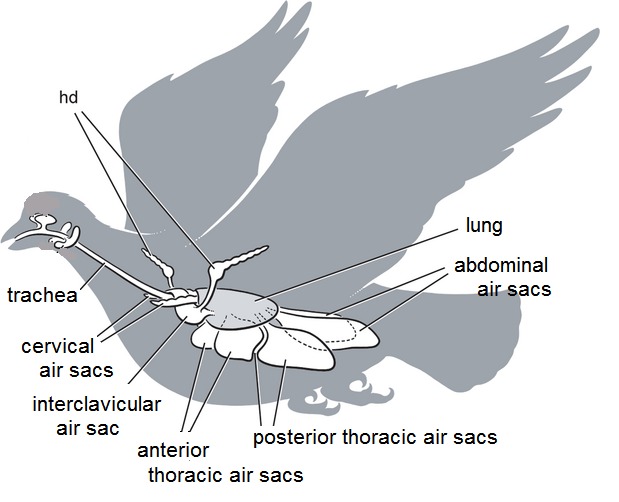
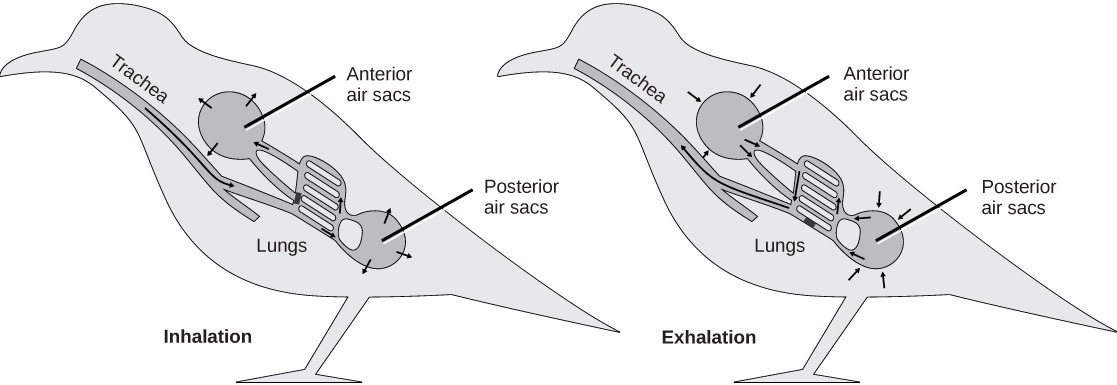
Birds breathe with lungs and a connected network of air sacs. The lungs contain the tissue that moves oxygen into the bloodstream and removes carbon dioxide. The air sacs expand and contract, which drives air through the respiratory system.
Air enters through the nares, the nostril openings on the beak, then passes along the upper airway and trachea into the bronchi. Inside the body, the lung tissue lies close to the body wall and connects to larger sacs that change volume as the bird breathes.
| Structure | Main role | Where it fits |
|---|---|---|
| Trachea and primary bronchi | Carry air | Form the passages into and out of the respiratory network |
| Posterior air sacs | Ventilate the lungs | Receive the tracked parcel of incoming air first |
| Lungs | Exchange oxygen and carbon dioxide | Hold the microscopic surfaces where gases cross between air and blood |
| Anterior air sacs | Ventilate the lungs | Receive the tracked air after it passes through the lungs |
Posterior or caudal means toward the tail; anterior or cranial means toward the head.
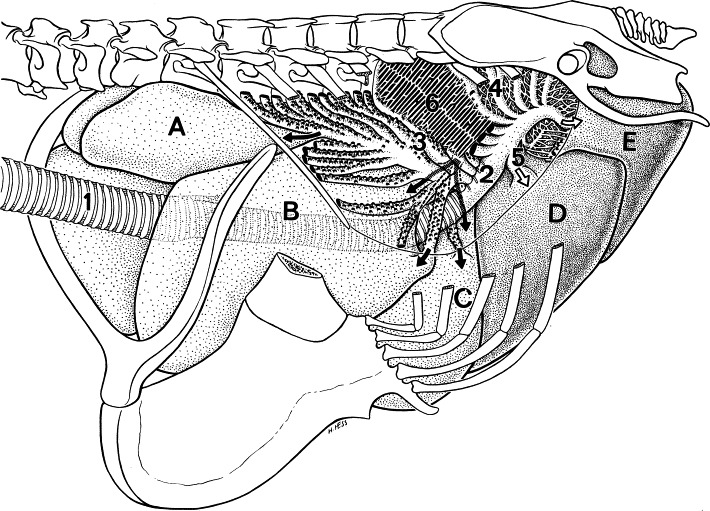
Air-sac shapes and arrangements vary among bird groups.
A 2025 scientific review by J. N. Maina describes the lung and air-sac network, including the differences between the main exchange pathways.
How Does Air Move Through a Bird in Two Breaths?
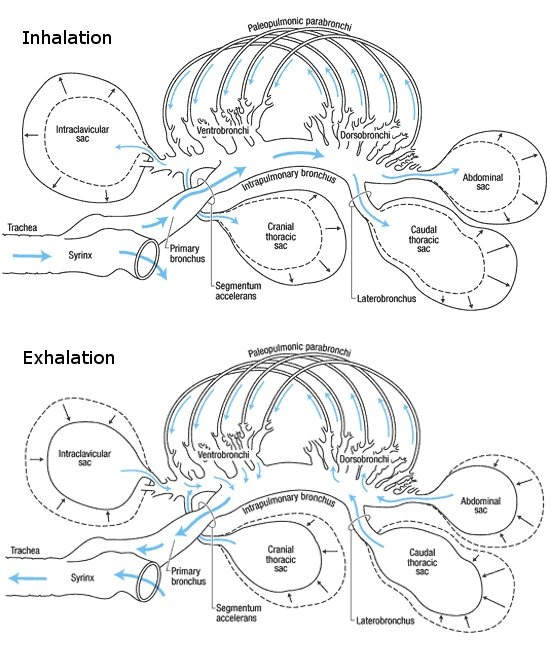
One parcel of air takes two full breathing cycles to pass through the bird respiratory route. Picture one puff of air dyed blue. The table follows that puff through four phases, while other air keeps moving through the system at the same time.
| Phase | Tracked parcel | Driving movement |
|---|---|---|
| First inhalation | Moves into posterior air sacs | Expansion draws incoming air through the airways |
| First exhalation | Passes from posterior sacs through lung exchange tissue | Posterior sacs compress and drive air through the lungs |
| Second inhalation | Moves onward toward anterior air sacs | The next expansion advances the tracked parcel |
| Second exhalation | Leaves from anterior sacs through the bronchial system and trachea | Compression pushes the tracked parcel out |
While the blue air sits in the posterior sacs, air from the previous breath is already moving through the lungs. On the next inhalation, new air enters the posterior sacs as the earlier air advances toward the anterior sacs. In the main exchange pathways, ventilation continues through both inhalation and exhalation, so oxygen transfer never pauses.
Where Does Oxygen Enter the Blood in a Bird?
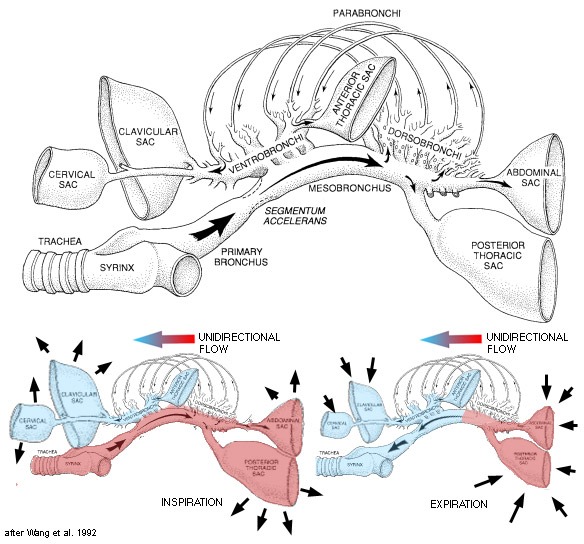
Oxygen enters a bird’s blood inside the lungs, across thin exchange surfaces associated with the parabronchi. These passages lead into networks of microscopic air capillaries lying close to blood capillaries.
Air capillaries contain respiratory air; blood capillaries carry blood past the exchange surface. Oxygen diffuses from air through the thin blood-gas barrier into the blood, while carbon dioxide passes in the opposite direction.
That transfer is gas exchange. The movement of air through the passages is ventilation. Air sacs keep air moving so the exchange tissue stays supplied.
Through the main paleopulmonic exchange region, airflow travels mostly from the caudal side toward the cranial side through successive breathing phases. This keeps conditions right for oxygen transfer as blood moves through the exchange network. Some neopulmonic passages can carry airflow in both directions, so the one-way description applies only to the principal paleopulmonic pathways.
How Is Bird Breathing Different From Human Breathing?
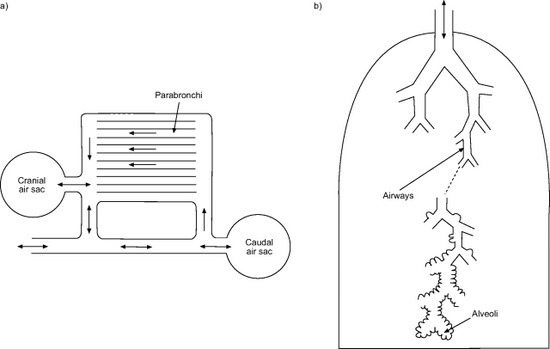
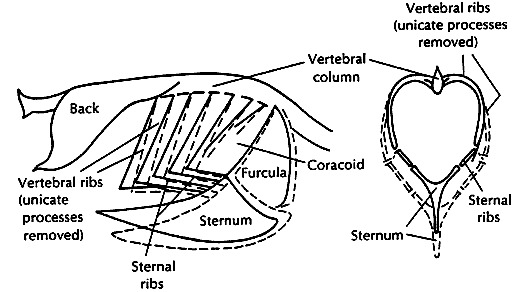
Human lungs expand and recoil during tidal breathing. Bird lungs stay rigid while movements of the ribs and sternum expand and compress the air sacs that ventilate them.
During a human inhalation, the diaphragm contracts as the chest cavity expands. Air moves into the lungs, where oxygen is exchanged across alveolar surfaces. During exhalation, air travels back along the airways, with some residual air remaining in the lungs.
Birds lack a mammalian-style diaphragm. As Cornell University’s avian anatomy guidance explains, rib and sternum movement ventilates the respiratory system.
| Feature | Human | Bird |
|---|---|---|
| Main ventilation movement | Diaphragm and chest wall expand the thorax | Ribs and sternum move the connected air sacs |
| Gas-exchange surfaces | Alveoli in expandable lungs | Air capillaries associated with parabronchi in rigid lungs |
| Air movement through the exchange region | Tidal flow in and out | Mostly one-way through the main paleopulmonic region |
| Structures that change volume substantially | Lungs | Air sacs |
Why Does This Breathing System Help Active Birds?
Flight demands substantial oxygen delivery. Birds meet it with coordinated air-sac ventilation and lung tissue specialized for gas exchange.
Inside the lungs, a fine network of exchange surfaces and a thin barrier between air and blood support diffusion. Air keeps moving through the exchange pathways, so oxygen moves into the blood and carbon dioxide moves out during activity.
What selection pressures first shaped these airflow features is a separate question. Researchers reported unidirectional airflow in alligator lungs in 2010, which shows this airflow organization occurs beyond birds. The finding points to a more complex evolutionary picture than a single flight-origin explanation.
How Do You Read the Arrows in a Breathing Diagram?
Arrows can trace the journey of one marked parcel, show air moving through a particular passage during one phase, or show oxygen diffusing across tissue into blood. Each type answers a different question, so identify which movement the arrows represent before you compare two diagrams.
Why Do Some Birds Breathe With Their Beaks Open?
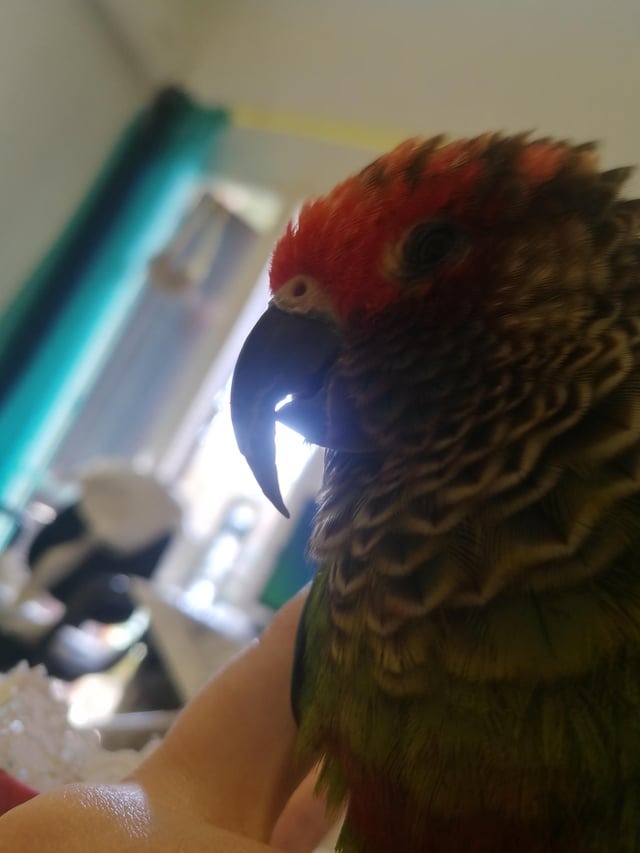
On a hot day, an open beak can be part of a bird’s cooling behavior. Some species also use gular fluttering, rapid movement of moist throat tissue that promotes evaporative cooling.
The U.S. Fish & Wildlife Service’s account of summer cooling explains how open-mouth breathing and gular fluttering help release heat. On a perched bird, you may see the throat moving.
Common nighthawks and double-crested cormorants are among the species the U.S. Fish & Wildlife Service identifies as using gular fluttering.
A public r/birding post describes someone working near a Bald Eagle that stayed in one area during hot weather:
I’m not trying to disturb him on purpose just he is on the way where I need to work. He been in that same spot all day yesterday, then today same thing. It’s pretty hot outside and he seems to be thirsty, because now he is breathing with an open mouth compared to yesterday
The post shows an open beak, heat and a bird that stayed put. It doesn’t tell you whether the eagle was cooling itself or unwell.
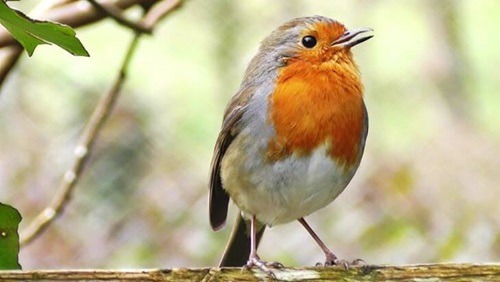
If you find a wild bird that looks sick or injured, call a qualified wildlife rehabilitator, as the U.S. Fish & Wildlife Service’s wildlife guidance recommends. From a respectful distance, note the weather, the bird’s posture and any visible throat movement, and pass those details on. An open beak alone is no reason to attempt treatment.